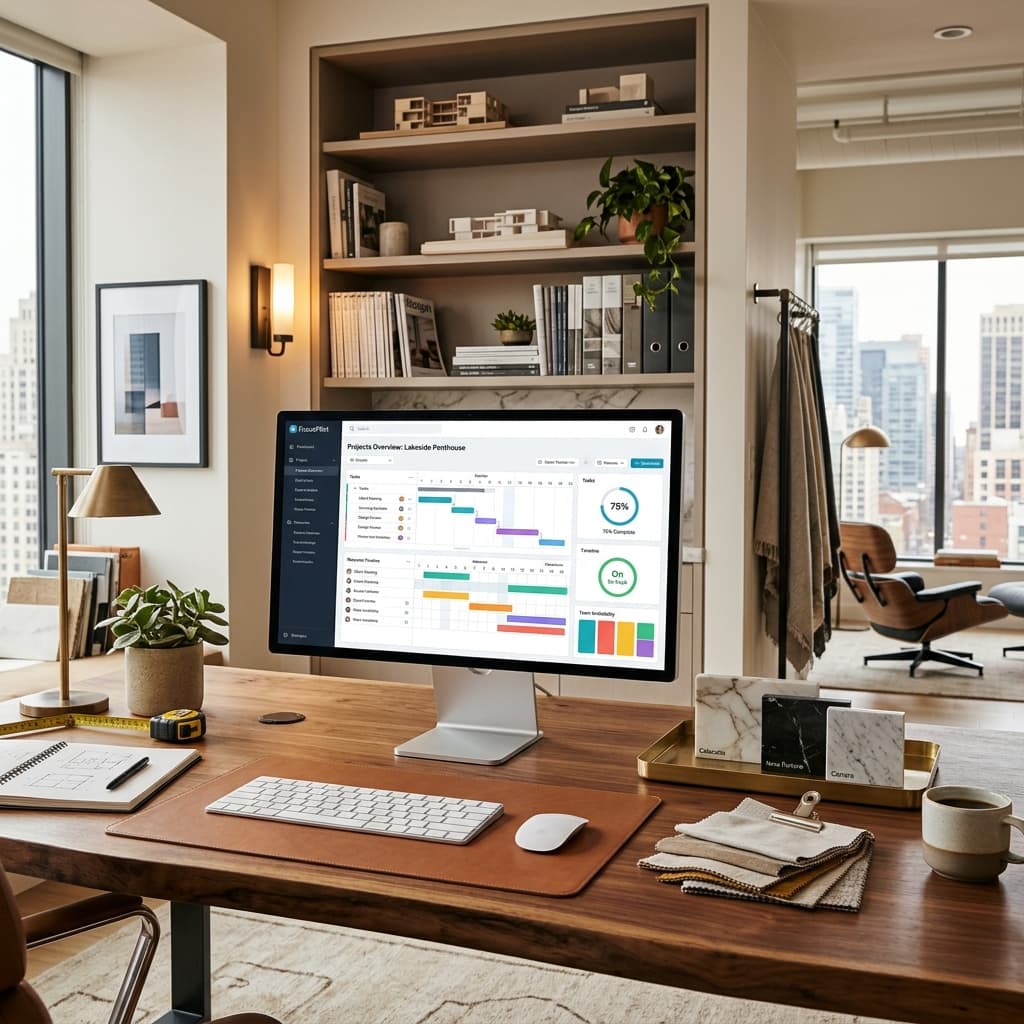

American interior design firms face a familiar stack: QuickBooks or similar for books, email for client decisions, spreadsheets for FF&E, and a project tool that never quite connects to how work really flows. Searching for interior design project management software in the US is usually the moment a studio admits the patchwork is costing margin—not just time.
Here is what US design businesses should demand from modern studio software, and how to choose a platform that supports residential, hospitality, and commercial work without forcing you into generic construction PM tools.
What US studios actually need from software
US firms range from solo designers to multi-city teams with dedicated procurement staff. Regardless of size, the operational spine is similar:
- Clear project phases from concept through install close-out
- FF&E specification and ordering with vendor lead times and client approvals
- Document control for drawings, finishes, and contracts
- Financial visibility per project—fees, COGS, mark-ups, and cash timing
- Client experience that feels premium, not like a generic ticket system
Software marketed only to "creative agencies" often lacks procurement depth. Software built for builders often overwhelms designers with RFIs and submittals you will never use. The right fit sits in the middle: design-native project management.
Accounting integration: QuickBooks and beyond
Many US studios run on QuickBooks Online. Your project platform should create invoices, track payments, and align project profitability with what finance sees—without weekly CSV rituals.
Also confirm support for Stripe if you collect deposits or approval-related payments through a client portal. US clients increasingly expect card options; reconciling those payments manually defeats the purpose of integrated software.
Procurement and vendor management at US scale
US projects often pull from national vendors, trade accounts, and custom fabricators across time zones. Your system should track:
- Specification status and alternates
- Purchase orders and deposits
- Freight and delivery windows
- Install sequencing dependencies
When procurement lives in email, the PM becomes the human integration layer—expensive and error-prone. Centralising status in the same tool as design tasks is how multi-project studios protect margin.
Client portal and approvals
US clients may tolerate email at small scale; they rarely tolerate chaos at $200k+ FF&E scope. A branded portal for selections, approvals, and files reduces "just circling back" loops and creates a defensible record when scope shifts.
Look for mobile-friendly portals, comment threads on selections, and clear approval timestamps—essential when disputes arise about who signed off on what.
Team collaboration across offices and time zones
Growing US firms split work between design, procurement, and project management. Role-based access, @mentions, and activity on the project record beat scattered Slack channels that lose context after ninety days.
Per-user pricing that scales fairly matters: studios should not be punished for adding a procurement coordinator mid-year.
AI for email volume and specification work
US inboxes are high-volume. AI-assisted drafting, thread summaries, and product sourcing suggestions save hours weekly when humans stay in the loop for final sends and spec decisions. The goal is faster throughput, not autopilot client communication.
Compliance and documentation (practical, not legal advice)
While this is not legal guidance, US studios routinely need organised contracts, change-order trails, and approval logs. Software that attaches decisions to the project timeline supports cleaner close-out and fewer "we never approved that" conversations.
Evaluation checklist for US firms
When comparing interior design software for US studios, test against a real active project:
- Build phases and assign owners with due dates
- Run one FF&E approval cycle through the client portal
- Issue a progress invoice and confirm accounting sync
- Review project P&L or budget vs actual in the same UI
Adoption fails when designers keep shadow spreadsheets "just in case." If the pilot does not replace those sheets, keep looking.
How Focuspilot supports US design businesses
Focuspilot unifies CRM, projects, procurement, client portal, and finance for interior designers and architects—with QuickBooks and Xero integration, Stripe payments, AI email and sourcing tools, and workflows built for design delivery rather than generic task lists.
See Focuspilot vs Programa and other comparisons, or start a free trial and run your next US project end-to-end in one workspace.